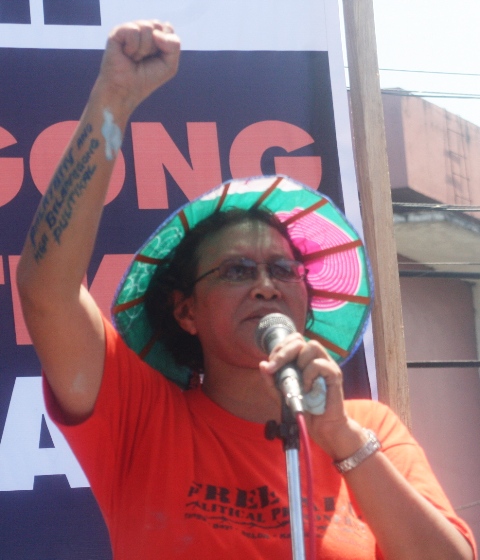
“Population control defeats the rights-based, health-based, pro-poor
characteristics of the RH Bill. As we call for the removal of population
control provisions in the RH bill, the retention of pro-poor provisions
lifted from Gabriela’s Comprehensive RH bill is non-negotiable.” – GWP
Rep. Luz Ilagan
By INA ALLECO R. SILVERIO
Bulatlat.com
MANILA — Maternal and child health care or population control?
In the escalating debate over the proposed reproductive health law,
Gabriela Women’s Party Representatives Luz Ilagan and Emmi de Jesus said
President Benigno Aquino III is engaging in double-talk. Aquino has
previously declared his support for the RH bill, but, the Gabriela
lawmakers said, instead of increasing allocations for public health
services, the administration has in fact slashed it.
This has prompted some quarters to conclude that Aquino’s support for
healthcare for women and mothers is fake, and his interest lies more on
the RH bill as a population control measure.
“Aquino is saying one thing yet doing the opposite. How can he claim
support for programs on reproductive health or even responsible
parenthood when he has cut the budget for health?,” said Ilagan.
Ilagan was referring to statements made by Aquino, September 22, when
he appeared at the annual meeting of the International Monetary Fund
(IMF) and the World Bank (WB) in Washington DC in the United States.
Aquino said he supports the RH bill because it will help educate parents
about birth spacing and responsible parenthood. Aquino also said the
proposal was never meant to be solely a means to promote contraceptives.
“For all of his supportive words, Aquino has done the opposite – he
has immobilized the government agencies and institutions tasked to
provide health services by implementing budget cuts. Responsible parents
must first have access to services to raise a healthy family,” Ilagan
said.
The Gabriela solon explained that in the 2012 budget, five of the 12
Metro Manila-based special hospitals, and 18 of the 54 local hospitals
nationwide did not t receive an increase in their allotment for
maintenance and operating expenses. The Department of Budget and
Management cut the DOH’s proposed budget from P80,143,863,00 (US$
186,381,076) to P42,771,536,000 (US$994,686.883)) The government
hospitals’ presentations also showed the negligible help that patients
get from PhilHealth. At the Philippine Children Medical Center, for
instance, PhilHealth accounts only for 14 percent of the total bill of
PCMC patients for the year 2010. Majority of the expenses were
shouldered by the patients, with 27 percent of the rest of the expenses
covered by promissory notes.
The budget for “Health Facilities Enhancement program” which, based
on Aquino’s budget message, is geared toward the improvement of maternal
health, and the well-being of infants was slashed from P7.1 billion
(US$162,790,697) in 2011, to P5.1 billion (US$116,27,907) in 2012.
“President Aquino should put his money where his mouth is and
demonstrate his sincerity in upholding women and children’s rights to
healthcare.”
US population control scheme in the guise of health projects?
President Aquino’s alacrity in supporting the RH bill, even as he
allotted a minuscule budget to health services, has already prompted
questions. Some quarters have said that Aquino’s stance on the RH bill
is heavily influenced by groups that promote population control because
these agencies are already giving financial and logistical support for
population control programs in the guise of health projects.
The allegations of several anti-RH bill senators such as Sen. Tito
Sotto that the RH bill is the handiwork of political and economic forces
that want to impose population control over the Philippines appears to
have some truth to it.
According to reports, he US Agency for International Development
(USAID) mission in the Philippines has, since 2007, been implementing
the PRISM Project, or the Private Sector Mobilization for Family Health
(PRISM) Project.
The USAID is the United States federal government agency primarily
responsible for administering foreign aid. It was established by former
US president John F. Kennedy in 1961 via an executive order to
implement development assistance programs in the areas authorized by the
Congress in the Foreign Assistance Act of 1961. As an independent
federal agency, it receives overall foreign policy guidance from the
United States Secretary of State. USAID’s stated goals include providing
“economic, development and humanitarian assistance around the world in
support of the foreign policy goals of the United States.” It operates
in Sub-Saharan Africa; Asia and the Near East, Latin America and the
Caribbean, Europe, and Eurasia.
In the Philippines, the Prism Project is already in its second phase
and, according to the USAID, it “ expands private sector provision of
health services on maternal and child health (MCH), and family planning
(FP), through workplace initiatives, market development and private
practice initiatives.” Specifically, Prism2 is also said to provide
financial and logistical support to the Department of Health,
Department of Labor and Employment, local government units (LGUs) and
other national and local partners when it comes to the delivery of
FP/MCH products and services. The project is being implemented in 78
provinces/independent cities nationwide from 2009 to 2014.
The USAID implements Prism2 also by coordinating with companies and
cooperatives to increase employees or cooperative members’ access to
family health information and services.
The USAID is also implementing a whole slew of projects that are
aimed supposedly to improving the quality of health of Filipinos,
specifically mothers and children. Through its Health Policy
Development Program (HPDP), the USAID continues to involve itself in the
development of what are supposed to be “appropriate policies and build a
systematic policy change process” in the DOH. The focus of the USAID’s
involvement is in developing contraceptive self-reliance/FP/MCH.
When it comes to health care financing, the USAID backs the DOH as it
implements schemes to ensure “sustainability of essential health
services, including expansion of the National Health Insurance Program
(NHIP), multi-year financing of the costs of priority health programs,
and ensuring equitable and efficient distribution of health resources
across the country.”
In a word, the schemes comprise “privatization.”
According to the USAID website, its health policy development program
runs an operations research project in Compostela Valley. There, the
agency is testing “an integrated approach for preventing mother and
child deaths through information and social mobilization.”
When it comes to its dealings with local government units, the USAID
has its Strengthening Local Governance for Health (HealthGov) Project
and the Sustainable Health Improvements through Empowerment and Local
Development (SHIELD) Project. Here, the US agency involves itself in
LGUs’ operations when it comes to establishing or maintaining health
systems, on matters of financing, and in health service provision. The
two projects are at the core of the the US agency’s health program
areas — maternal and child health, family planning, HIV/AIDS,
tuberculosis and emerging infectious diseases in areas in the
Autonomous Region of Muslim Mindanao (ARMM) thru the Shield Project) and
non-ARMM areas (through HealthGov).
HealthGov is said to focus on maternal and child health. Through the
project, the USAID develops technical assistance products such as a tool
to access the health department’s MCH grants by local governments. The
project also supports advocacy for increased funding support and
improved programs on MCH and other health issues.
As for the Shield Project, it is the means by which the USAID
involves itself in local communities in coordination with local
governments. The project sends Community Health Action Teams (CHATs),
which supposedly assist health service providers in caring for mothers
and newborns, including early detection and referral of mothers and
newborns with complications.
In the meantime, it’s not just health programs that the USAID mission
to the Philippines is involved in. It also works closely with the US
Department of Defense through the Joint US Military Assistance Group
(JUSMAG) in pushing for peace and security programs.
“This well-established civilian-military cooperation has enhanced the
effectiveness of US foreign assistance, spread the benefits of
assistance more widely, and fostered goodwill towards America among the
Philippine people,” the USAID described the JUSMAG in its website.
Wikileaks on RH bill
Former US ambassador to the Philippines Kristie Kenney in a cable
exposed by Wikileaks has also commented on the RH bill, saying that
there were ““Landmark appropriations and draft legislation reflect
increasing commitment within the Philippine Government to further expand
and sustain programs started forty years ago with US. Government’s
assistance through USAID.
Kenney said in a cable, sent from Manila to Washington, DC in July
2008 that the US”continues to be the largest donor in the Philippine
population sector supporting efforts to improve local government service
delivery and increase private sector contributions to family health
outcomes.”....
MORE
Source: Bulatlat.com
URL:
http://bulatlat.com/main/2011/09/26/population-control-us-and-aquino-governments%E2%80%99-hidden-agenda-%E2%80%93-gabriela/